Passive vs Active Fire Resistance
Buildings are susceptible to fire. Structural materials, furnishings, and decorations can, and often are, made out of combustible materials. There are two ways that are used in engineering to mitigate the challenge of fire in buildings: passive and active.
Passive
Passive fire resistance methods are always present, and don’t require maintenance. In includes using non-combustible building materials (concrete over wood) and compartmentalizing the fire by using fire walls and doors to separate parts of the building, as well as utilizing set-backs to keep fire away from sources of fuel.
Active
Active fire resistance often mean sprinklers. These fire suppression systems can be further augmented by human processes that keep areas decluttered and surfaces clean.
What’s Better
Passive systems are superior because they do not need to be thought about or maintained. They are present from Day 1 and do not need to be turned on or setup. See the CMU stairwell standing after the fire.
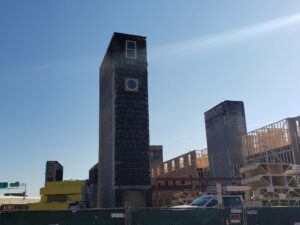
In modern engineering we seem to apply equal weighting to these strategies to get to the all important fire rating. Simply put all effort should be made to meet the fire rating through passive methods, BEFORE considering active strategies.
Active strategies can provide important redundancy and critical performance during a fire. However, active systems can critically fail. If several buildings are simultaneously on fire or the power to water pumps are out, then there is insufficient water pressure to power the sprinklers. This active system isn’t doing anything. And, this series of events isn’t rare enough to be ignored.
Unfortunately, modern engineering is letting cost drive design. Promoting ad-hoc approaches where coatings and surface modifications are trying to compensate for poor material selection that ultimately creates a better structure.
Are you thinking about how you build?

VP of MasonryTed Kelly
Latest News
Saving on School Construction
A new school is a big financial and community investment. It makes a community more attractive to students, teachers, families, […]
Insurance: Impacted by Material Choices
With the increased risk of disasters and the cost of construction; insurance costs are up. But, they aren’t going up […]
Wastefully Fixing Traffic Barriers
On I-495 and I-270, MDOT has been stapling Steel W-Beam Barriers to crumbling concrete barriers. What happened to these barriers? And […]
Building for Tomorrow, Today
Every building or structure has a designated lifetime: 30 years, 50 years, 100 years. However what happens when the conditions […]
