Lower Carbon Concrete: A Silver Bullet
If we want to keep building and not break the Earth, we need to reduce our CO2 emissions. One simple product switch could save us 6% of the embodied carbon in a building (cradle-to-gate).
–unbridled sales pitch over–
We aren’t going to stop building with concrete. And with our focus on reducing the CO2 associated with concrete, we’ve been looking in the wrong place. While we’ve brought everything we could think of to the table: better specs, SCM’s, carbon capture, etc. We stopped looking inside. Every time you build with concrete you use rebar. And simply put steel rebar emits a lot of CO2, but there hasn’t really been a good alternative.
Fiberglass rebar has entered the chat
Some background: Fiberglass rebar (glass fiber reinforced polymer [GFRP]) has been around for 4+ decades. It is a mixture of glass fibers for high tensile strength and polymer resin to form a lightweight composite bar. Because it contains no iron, it does not corrode (rust). Without metals it is non-conductive and non-magnetic. From an engineering (read: code) perspective fiberglass rebar can be a better than 1:1 replacement with steel rebar. However, for argument’s sake we will proceed through the carbon savings as if it were a 1:1 substitution.
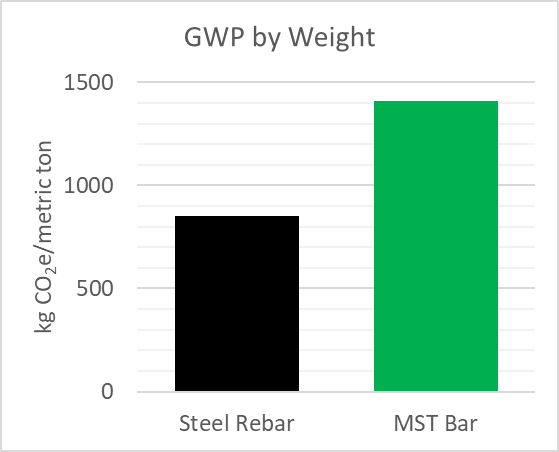
But remember it’s 80% lighter per foot. So really this is the comparison:
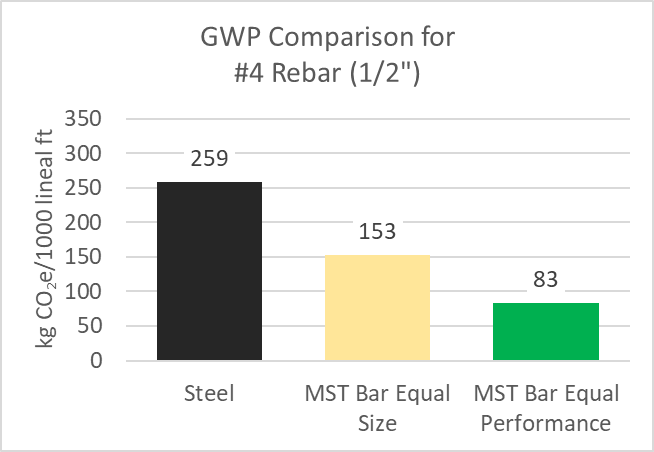
Showing a whopping 41% reduction in GWP emissions! This number jumps to 68% on a true performance basis.
Building Level
When looking at the embodied carbon of an average building about 50% of the embodied GWP emissions is due to concrete. (Carbon Leadership Forum) However, +15% is due to the steel rebar in the concrete. A better way to look at this is reinforced concrete accounts for 65% of a building’s embodied carbon. A 40% reduction of a 15% component is 6%.
To get this same savings from concrete you would need to find a 12% savings in your concrete. Not out of the realm of possibility, but I would like to give a bit of scale.
- The U.S. Government in its sustainability push under the previous administration deemed any concrete mix that saves 20% over standard as Low Embodied Carbon Concrete. Switching to fiberglass rebar has about half of the same impact on the structure: 12% for concrete vs 6% for fiberglass rebar.
- Furthermore concrete producers are ecstatic about Portland Limestone Cement (PLC) which results in a 10% carbon savings. Switching to fiberglass rebar has the same impact: 5% for PLC vs 6% for fiberglass rebar.
Better yet, if you did made any of these reduction to concrete you would get additive CO2 savings. So pair a 40% savings in rebar with a 20% savings in concrete and you just cut your TOTAL building’s carbon emissions due to reinforced concrete nearly 25%. NOW THAT IS A BIG DEAL!
But Wait There’s More
By the way these embodied carbon values in an EPD only go to the plant gate. Shipping something lighter means fewer loads and less fuel in transportation.
BUT WAIT THERE’S STILL MORE on the jobsite handling a lighter material means crews and equipment work quicker.
BUT WAIT THERE’S EVEN MORE concrete that doesn’t corrode and spall is going to last, making truly resilient and long-lasting structures.
So why haven’t you made the switch to MST Bar?
About the Author:
Dr. Aaron Fisher’s career has been defined by a singular pursuit of leaving the world better than he found it (read: doing this smarter). Dr. Fisher has a PhD in Chemical Engineering from the University of Maryland and a B.S. in Chemistry from Duke University. He is currently the Vice President of Business Development for Ernest Maier; a family-owned company. Dr. Fisher is responsible for PaveDrain a heavy duty, low-maintenance permeable pavement and fiberglass rebar, a stronger, more sustainable, corrosion-proof alternative to steel rebar. Dr. Fisher has a deep technical background in all aspects of sustainability. He has served as a contractor to several programmatic offices within the U.S. Department of Energy- Energy Efficiency and Renewable Energy Office. He led the innovation program at Water Research Foundation on behalf of wastewater, stormwater, and drinking water utilities across the United States. He also started a company commercializing his graduate research on safer lithium batteries.
Sources
- Industry-Average Environmental Product Declaration. Concrete Reinforcing Steel Institute Issued 2022
- Product Specific Environmental Product Declaration. MST Bar. Issued June 2025
- Low Embodied Carbon Concrete Standards for all GSA Projects. September 2022
- Embodied Carbon: Key Considerations for Key Materials. Carbon Leadership Forum Anthony Pak

VP of Business DevelopmentAaron Fisher
Latest News
Saving on School Construction
A new school is a big financial and community investment. It makes a community more attractive to students, teachers, families, […]
Insurance: Impacted by Material Choices
With the increased risk of disasters and the cost of construction; insurance costs are up. But, they aren’t going up […]

Wastefully Fixing Traffic Barriers
On I-495 and I-270, MDOT has been stapling Steel W-Beam Barriers to crumbling concrete barriers. What happened to these barriers? And […]

Building for Tomorrow, Today
Every building or structure has a designated lifetime: 30 years, 50 years, 100 years. However what happens when the conditions […]
