Fiberglass Rebar
Why Rebar in Concrete
As a slab of concrete bends one face is compressed, and the other is stretched (under tension). Concrete is very strong under compression, but is not nearly as strong under tension. To overcome this weakness reinforcing bar (rebar) is added in the concrete. Rebar is used in concrete to add tensile strength making stronger building materials. Steel has high tensile strength and is affordable making it the rebar material of choice. Steel is also easy to work, albeit it is heavy and difficult to cut.
Steel Rusts
The challenge with steel as rebar material has been the fact it rusts. As steel corrodes it expands causing the concrete to spall. To combat this rebar is generally set deeper into the concrete (limiting its effectiveness) and the concrete mix is adjusted to inhibit corrosion and resist spalling.
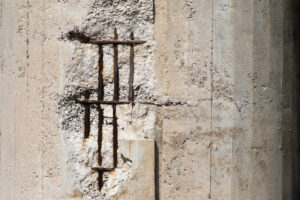
Concrete spalling caused by rusting reinforcement bars.
Steel Alternatives
Several steel rebar alternatives have been proposed to address this critical challenge. Things like carbon fiber, fiberglass, and basalt are all commercial alternatives. However, they have been limited until recently because their benefits did not outweigh their costs– until recently. With steel prices escalating quickly and fiberglass production costs coming down fiberglass rebar is now available at a price below that of steel.
Why Fiberglass Rebar
More Information on Fiberglass Rebar Available from Ernest Maier
- Residential and Light Commercial Bars: Replace one bar size larger
- Structural Bars: Full array of structural steel rebar replacement
- More

VP of Sales- Accessory DivisionMike Simon
Latest News
Saving on School Construction
A new school is a big financial and community investment. It makes a community more attractive to students, teachers, families, […]
Insurance: Impacted by Material Choices
With the increased risk of disasters and the cost of construction; insurance costs are up. But, they aren’t going up […]

Wastefully Fixing Traffic Barriers
On I-495 and I-270, MDOT has been stapling Steel W-Beam Barriers to crumbling concrete barriers. What happened to these barriers? And […]

Building for Tomorrow, Today
Every building or structure has a designated lifetime: 30 years, 50 years, 100 years. However what happens when the conditions […]
